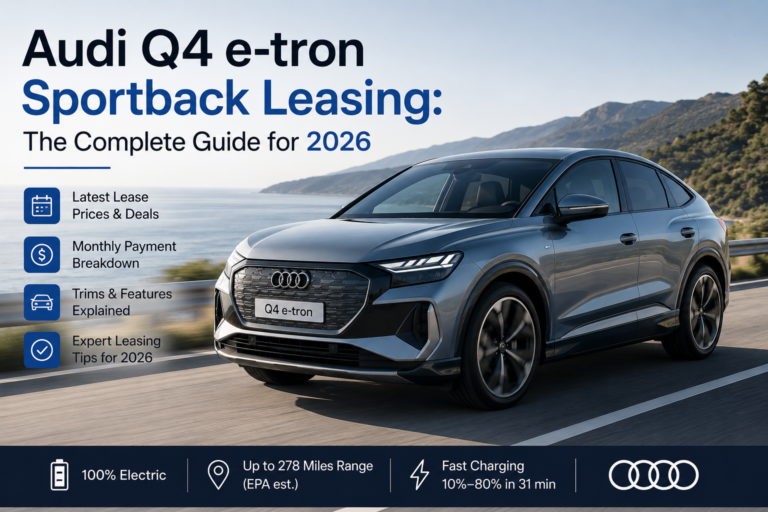
Audi Q4 e-tron Lease

Audi Q4 e-tron Lease: What You’ll Actually Pay in 2026
I’ve had a few friends ask me about the Audi Q4 e-tron lately, and the question is almost always the same: is leasing one actually worth it, or is it just a nicer-looking way to overpay for a Volkswagen underneath? Fair question. The Audi Q4 e-tron shares plenty with VW’s MEB platform, sure, but Audi wraps it in a cabin that genuinely feels a class above, and that’s the part a spec sheet won’t tell you. Leasing tends to make sense here for reasons that have less to do with the car itself and more to do with how fast this whole segment is moving. Battery tech gets better every eighteen months or so. Incentive rules get rewritten more often than anyone would like. And nobody really knows yet what a five-year-old EV battery is worth on the used market. A lease sidesteps most of that uncertainty. You’re not stuck holding the bag if next year’s version charges faster or goes another forty miles on a charge.
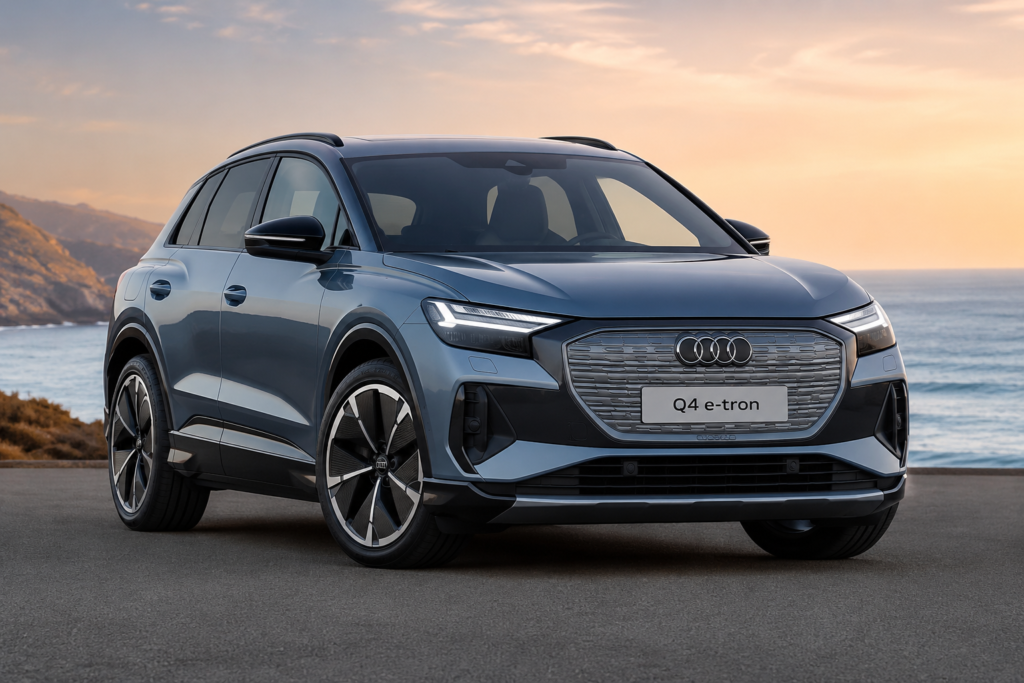
Why Leasing Beats Buying Here
Gas cars depreciate on a fairly predictable curve. EVs don’t, not yet anyway, because the technology itself is still shifting under everyone’s feet. Buy an Audi Q4 e-tron outright and you’re betting that its resale value holds up three or four years from now, against whatever Tesla, Hyundai, or Audi’s own next-gen Q6 e-tron happens to be offering by then. Lease it instead and that bet isn’t yours to make. Hand the keys back, walk into whatever’s newest and best at the time, repeat.
There’s also a wrinkle worth knowing about, and it’s one a lot of shoppers miss entirely. Because many EV leases get structured through the manufacturer’s finance arm as a commercial lease rather than a retail sale, the federal clean vehicle credit sometimes gets applied by the leasing company itself and passed along to you as a straight-up rebate — even in cases where you personally wouldn’t have qualified for that credit had you bought the car outright. Not every dealer handles this the same way, and the rules shift depending on who’s writing the paper, so just ask. Directly. Get it in writing if you can.
What Lease Payments Actually Look Like Right Now
Here’s where I have to give you an unsatisfying answer: it depends, a lot, on where you live and which dealer you walk into. As of mid-2026, published lease specials on the Audi Q4 e-tron have shown up anywhere from around $365 a month up past $700, and that gap isn’t a typo. Term length, down payment, trim, and how much manufacturer lease cash a given region has that month — all of it moves the number around, sometimes by a couple hundred dollars for what looks like the same car.
So when you see an ad screaming “$365/month!” treat it the way you’d treat a too-good headline on anything else. Somebody put a few thousand dollars down to get there, probably signed up for fewer miles per year than you’d actually drive, and grabbed whatever trim happened to be sitting unsold on that particular lot. None of that’s dishonest exactly. It’s just not the number you’ll likely be quoted once you sit down at the desk.
Money Factor and Residual Value — the Two Numbers Nobody Explains
Almost nobody walks into a dealership understanding these two terms, and dealers, frankly, don’t go out of their way to fix that.
Money factor
Think of it as the lease world’s version of an interest rate, except it’s written as a tiny decimal instead of a percentage — something like .00289 — which makes it look smaller and less important than it is. Multiply it by 2,400 and you’ll get a number that roughly compares to an APR. Audi Financial Services sets a standard rate each month, and putting more money down can sometimes buy it down a touch, kind of like paying points on a mortgage, though not every dealer will offer that.
Residual value
This is Audi’s prediction of what the car will be worth when your lease ends, shown as a percentage of MSRP. Audi Q4 e-tron residuals have generally sat somewhere in the low-to-mid 50s percentage-wise, occasionally into the high 50s or low 60s depending on trim and term — though that shifts with used-EV pricing, which itself has been a little volatile. A higher residual shrinks the gap the lease has to cover, which is really just a fancy way of saying your payment goes down.
Ask for both numbers before anyone quotes you a monthly payment. Not after. Before.
Trims: Where the Payment Math Gets Weird
The Audi Q4 e-tron comes in a few flavors, and unlike buying the car outright, the trim differences hit your lease payment in ways that aren’t always intuitive. Premium is the entry point — lowest sticker price, easiest number to hit, though it skips some of the driver-assist tech people expect at this price point now. Premium Plus tends to be where most buyers actually land, since it adds the tech and convenience packages without pushing the MSRP into Prestige territory. Prestige is loaded, no argument there, but the higher starting price can eat right through whatever lease cash Audi’s offering that month.
Then there’s the RWD versus quattro question — the badges read 40 for rear-wheel drive, 50 or 55 for quattro all-wheel drive. Quattro adds a few thousand to the sticker, and depending on the month, that can move the residual percentage in either direction, which is honestly a little counterintuitive the first time you see it. Here’s the part almost nobody expects: sometimes a mid-tier Premium Plus with strong incentives that month actually leases cheaper per month than a bare-bones Premium with none. Ask for quotes on two adjacent trims before you sign anything. It costs you nothing and occasionally saves you real money.
Incentives Worth Chasing Down
Past the federal credit pass-through already mentioned, there’s usually more on the table than what’s printed on the window sticker. Manufacturer lease cash is the big one — a flat credit knocked off the cap cost that often moves your payment more than anything else in the deal. Loyalty and conquest bonuses show up too, aimed at current Audi owners or people trading out of a competing brand. Some states and local utilities layer their own EV rebates on top, separate from and often stackable with the federal credit. And then there’s the money that never makes it into any ad at all — dealer-specific cash that a store will sometimes cough up if you simply ask, or better yet, show them a competing quote from the dealership down the road.
State EV incentive programs change often enough that checking your state’s energy office site directly beats trusting whatever the finance manager tells you off the top of their head.
Mileage Limits, and Why the Overage Fee Sneaks Up on People
Most Audi Q4 e-tron leases default to 10,000 miles a year, with bumps to 12,000 or 15,000 usually available for a modest increase in your monthly payment. Go over whatever you agreed to and you’re typically looking at somewhere around 20 to 30 cents per mile once the lease ends — which sounds small until you realize an extra 3,000 miles could run you close to a thousand dollars at turn-in.
The fix is almost embarrassingly simple and people still skip it: it’s nearly always cheaper to buy the extra miles upfront, folded into your monthly payment, than to pay the penalty at the back end. If your commute is anywhere close to the line between 10,000 and 12,000, just run both numbers before you sign. Takes five minutes.
Don’t Forget Charging Costs When You Budget This Out
Your lease payment is only one piece of what this car actually costs you monthly. Charging at home on a Level 2 setup is fairly cheap for typical driving — nowhere near what you’d spend on gas for a comparable SUV. Public DC fast charging is a different story; it costs meaningfully more per kilowatt-hour, and if you’re leaning on it regularly instead of charging overnight at home, that adds up faster than most people expect. The EPA’s fueleconomy.gov site publishes official efficiency numbers and estimated annual energy costs for the Audi Q4 e-tron, and it’s a far more reliable starting point than whatever ballpark figure a salesperson throws out.
Mistakes That Quietly Cost People Money
A few things trip up lease shoppers over and over. Rolling negative equity from a trade-in into the lease’s cap cost is a common one — it inflates the whole deal instead of getting negotiated as its own line item. Putting a big chunk of cash down at signing is another; that money isn’t coming back if the car gets totaled or you end up returning it early. Skipping gap insurance matters more here than on a typical lease too, given how quickly EV values have been moving. Some Audi Q4 e-tron lease programs have bundled in a home charger and installation credit at various points, so ask whether that’s currently on the table. And the advertised payment almost never includes tax — in most states, that gets added on top.
So, Is the Audi Q4 e-tron Actually a Good Lease Right Now?
If you want a well-built, genuinely comfortable electric SUV and don’t need to win a stoplight drag race or brag about the fastest charging curve on the market, the Audi Q4 e-tron leases reasonably well whenever the incentives line up. It won’t out-tech a Model Y, and it won’t out-charge a Hyundai Ioniq 5 either. What it does have is a cabin that feels noticeably nicer than either of those on a daily basis, which matters more than a spec sheet suggests once you’re actually living with the car.
The honest caveat, and I’ll say it plainly: because pricing swings so much by region and by month, a deal that looks great in one city can be mediocre thirty minutes down the highway. Get quotes from two or three dealers minimum. Ask for the money factor and residual in writing. Don’t let anyone rush past those two numbers to get to the monthly payment — that’s usually where the extra profit gets hidden.
A Few Questions People Keep Asking
Bottom Line
An Audi Q4 e-tron lease can be a smart way into a nicely built electric SUV, no question. Just don’t take the first number a dealer gives you at face value. Ask for the money factor, the residual, and every incentive by name before signing anything, and get at least one competing quote so you actually know whether what’s in front of you is a good deal or just an average one dressed up nicely.